Home / All / Applications and Technology / Why do belts fail prematurely on stranding and bunching machines?
Why do belts fail prematurely on stranding and bunching machines?
Stranding and bunching machinery operates under severe centrifugal stress, high torque fluctuations, and sudden start-stop acceleration cycles, leading to premature drive belt failures via several key mechanisms:
- Tensile Cord Elongation & Fatigue: Standard fiberglass or polyester cords slowly stretch and micro-fracture under high centrifugal loads, causing structural elongation, tension loss, and tooth jump.
- Dynamic Hysteresis & Heat: Continuous flexing around compact pulleys at extreme RPMs generates high internal heat, degrading rubber compounds and causing cord delamination or tooth shear.
- Lubricant Penetration: Continuous mist and overspray from drawing fluids and gear oils compromise standard rubber, swelling materials and inducing belt decay.
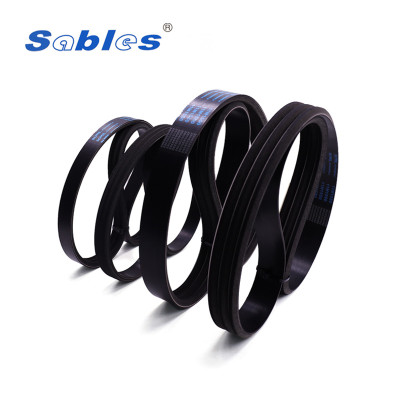
Sables solves these issues by engineering flat transmission belts and timing belts utilizing high-tensile aramid (Kevlar) or reinforced steel cords coupled with oil-resistant chloroprene compounds, offering zero-stretch stability and impact absorption.

Are you looking for a reliable conveyor belt manufacturer?
We can quickly provide customers with market analysis, technical support and customized services.
Contact Person

- Full Name:
- Laurence Yu
- Tel:
+86 13661623550
- Email:
- yutip@sables.cn
- WhatsApp:
- 8613661623550
- Address:
- Jiangxi Kangqi Industrial.Co., Ltd , Factory Address: Denggu Road, Guixi Industrial Park, Yingtan City, Jiangxi Province, China