What is the difference between PK, PJ, PH, PM, and PL series?
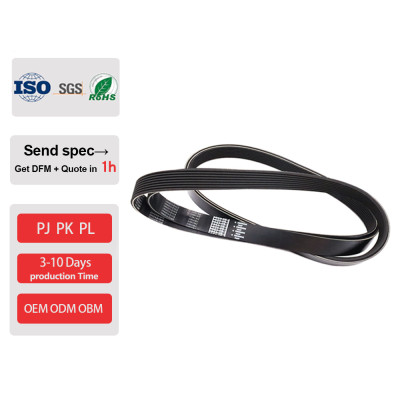
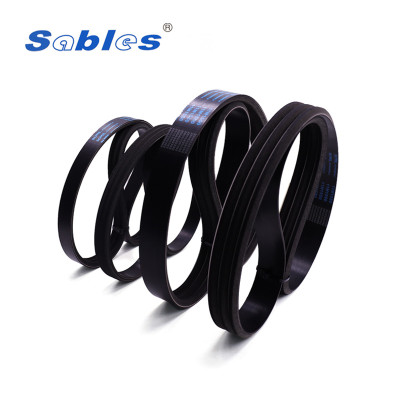
The operational distinctions between PK, PJ, PH, PM, and PL series are defined by the dimensional pitch (the distance between the centerlines of adjacent ribs) and the cross-sectional profile height of each rib design. Each lettered code represents an international standard cross-section scaled for specific torque and speed ratios:
| Belt Series Profile | Standard Structural Configuration | Target Industrial Machinery & Applications |
|---|---|---|
| PK & PJ Series | Features a narrow profile profile (typically 3 ribs for PK, 4 ribs for PJ). Highly flexible, allowing for ultra-compact drives with minimal pulley diameters. | High-speed office equipment, copiers, household appliances, washing machines, and small electric motors. |
| PH Series | Standard medium profile configuration (typically 5 ribs). Offers stable, low-vibration power transmission for general equipment. | Industrial motors, commercial pumps, light processing line drives, and HVAC fans. |
| PM & PL Series | Extra-wide profile structures (6 ribs for PM, 8 ribs for PL). Built with heavy-duty tension cords to handle massive torque spikes and shock loads. | Heavy machinery, industrial air compressors, large power generators, textile spinning frames, and agricultural machinery. |
Increasing the number of ribs broadens the surface contact zone with the pulley, expanding the absolute power transmission capacity. Sables can mold custom rib counts outside standard configurations to meet non-standard OEM machinery footprint limitations.
Are you looking for a reliable conveyor belt manufacturer?
We can quickly provide customers with market analysis, technical support and customized services.
Contact Person

- Full Name:
- Laurence Yu
- Tel:
+86 13661623550
- Email:
- yutip@sables.cn
- WhatsApp:
- 8613661623550
- Address:
- Jiangxi Kangqi Industrial.Co., Ltd , Factory Address: Denggu Road, Guixi Industrial Park, Yingtan City, Jiangxi Province, China